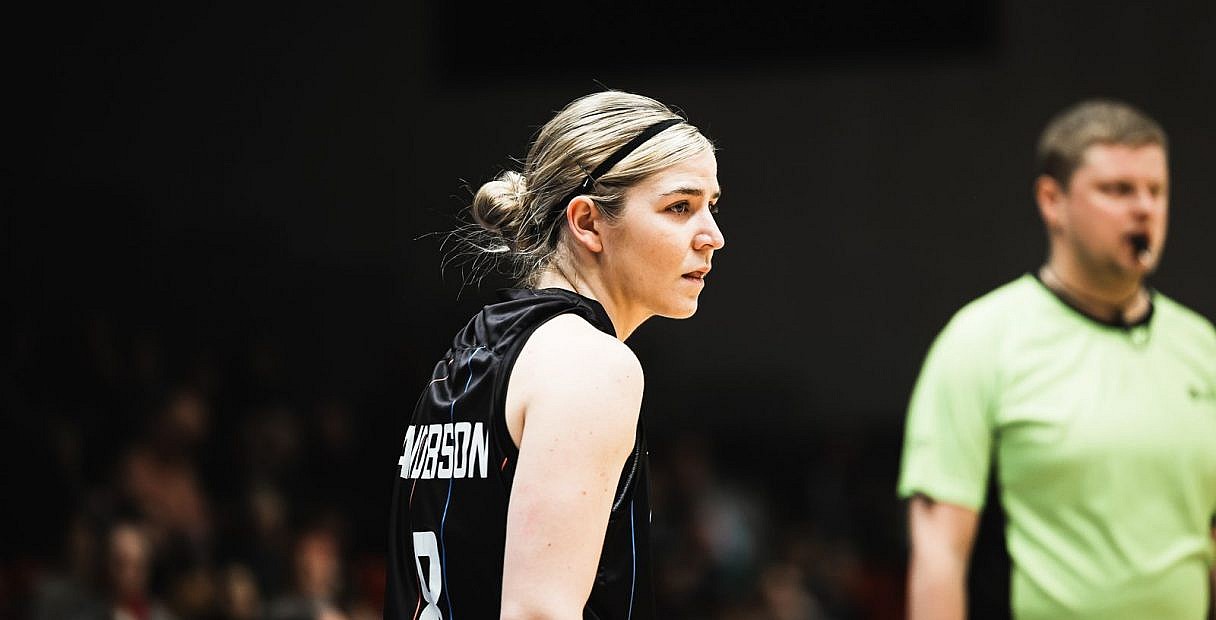
Former Great Britain international and Commonwealth Games silver medallist Georgia Anderson has spent a lifetime defying expectations — on and off the basketball court.
Now the Manchester Basketball star is using her story to prove that living with Type 1 diabetes is no barrier to elite performance.
Balancing blood sugar and basketball
When Georgia Anderson takes to the court for Manchester Basketball, precision is everything. Every pass, every shot, every surge to the basket demands focus. Yet, behind the scenes, another level of calculation is constantly at play — how much insulin, how many grams of carbohydrate, how the next play might affect her blood sugar.
“I think 50 per cent of my brain capacity is spent thinking about what I’m eating, where my sugars are and how that affects things on a day-to-day basis,” she confesses. “It’s a lot.”
Anderson was just seven when she was diagnosed with Type 1 diabetes. “At the time I hadn’t heard of diabetes before — neither had my parents — so it was all very new,” she recalls. “I remember feeling scared and not knowing what was going to happen. But my parents handled it incredibly well. I never felt their stress. I owe them so much.”
That early support — from her family and the nurses who she still keeps in touch with today — laid the foundations for a career that would see her represent Great Britain and win a silver medal with Team England at the 2018 Commonwealth Games.
Finding control
Type 1 diabetes means Anderson’s body no longer produces insulin, the hormone that regulates blood glucose. Managing it means constant vigilance — and, for a professional athlete, the stakes are high.
“When I first moved to college, I was cooking for myself and dealing with the pressure to perform,” she says. “I became fearful of going low during practices and games, so I let my sugars run high. At the time I didn’t see it as a problem, but later my doctors warned me about future health risks. That was the wake-up call I needed to make a change.”
Technology has transformed her ability to stay on top of the condition. “The insulin pump and continuous glucose monitor have been game changers,” she says. “Doing multiple injections every day was hard. The Omnipod 5 and Dexcom G6 work together and communicate how much insulin I need. It’s made a huge difference and prolonged my career.”
Family first
Basketball runs in the Anderson family. Her father, a former player turned coach, not only helped hone her game but instinctively knew when something wasn’t quite right.
“He could often see the signs before I could,” she smiles. “If I was going low or too high, he’d just ask, ‘Are you good?’ It was a simple question but it carried extra meaning. For me, it was reassurance — someone on the sideline who truly understood.”
That same partnership and awareness took on new meaning when Anderson decided to start a family. “When we decided to have a baby, I had to stop playing completely,” she says. “Pregnancy made it so much harder to control my blood sugars. You have to be incredibly strict. It was tough, but in the end I had a healthy baby and I’m so grateful for that.”
Breaking misconceptions
The idea that diabetes and sport are incompatible is one of the myths Anderson is determined to challenge.
“One of the biggest misconceptions is that you can’t eat certain things,” she explains. “People see you with a chocolate bar and say, ‘Can you eat that?’ Yes, I can — I just need to adjust my insulin. Another is that diabetes is caused by eating too much sugar. For me, my pancreas just stopped working. It wasn’t about diet.”
She pauses. “And then there’s the idea that you shouldn’t play sport. I heard that after I was diagnosed, but my parents never changed anything for me. I carried on playing basketball and I hope I’m proof that it’s possible.”
Striking out stigma
Anderson is now working with Diabetes UK as part of the Strike Out Stigma campaign — an initiative designed to raise awareness, tackle myths and build confidence among people living with diabetes. She wants to be the role model she never had.
“Growing up, I didn’t know any other diabetic athletes,” she says. “Now, parents contact me about their children who’ve been diagnosed. If I can provide a bit of reassurance, that means a lot.”
She’s quick to credit those around her. “I’ve had great coaches, supportive team-mates and staff who’ve asked questions and wanted to learn. That makes such a difference. Clubs can do so much just by taking time to understand the condition.”
A message to the next generation
Living with diabetes has made Anderson more disciplined and self-aware. “There are so many factors that influence blood glucose — food, exercise, stress, sleep, hormones,” she explains. “I have to consider all of them every single day. It definitely makes you more focused.”
Her advice to young people newly diagnosed? “It’s possible. I hope I’m an example of that. I didn’t have many diabetic athletes to look up to, but I want others to know they can still achieve everything they want.”
She smiles when asked what she’d tell her seven-year-old self. “You’re going to be okay. Everything’s going to work out. You’ll play basketball for a long time and you’ll have a family. Anything is possible.”