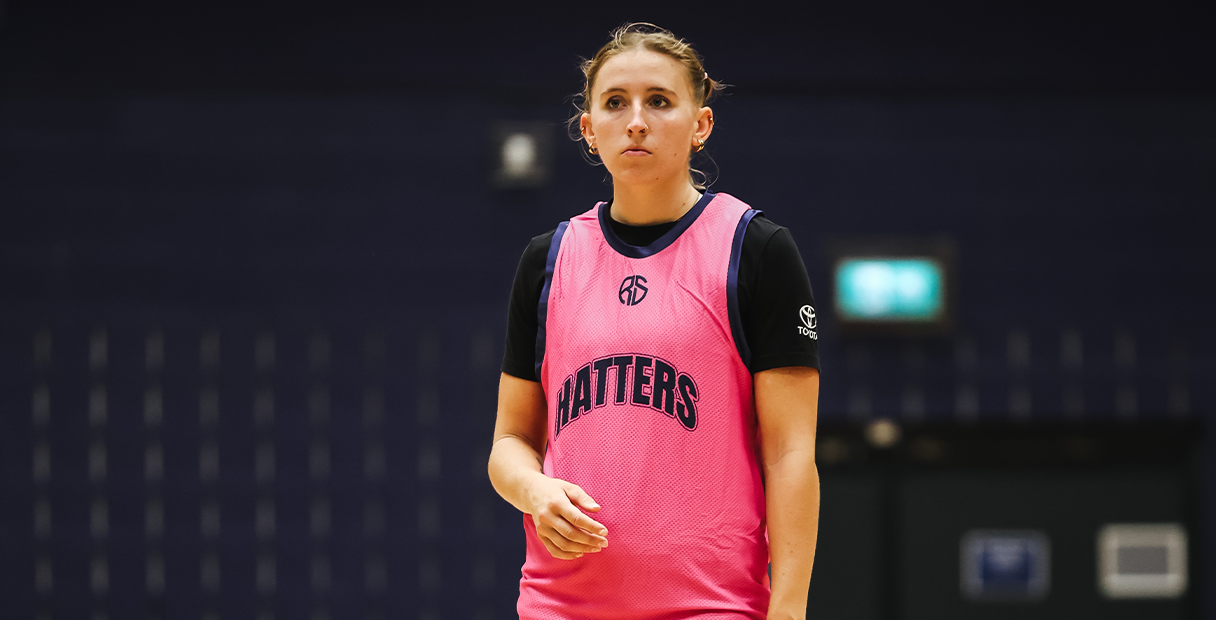
For Rachel Cockman, the journey to professional basketball was never really a question of whether she would make it. The question was how.
Growing up in the small Alaskan town of Cantwell, with a population of around 200 people and limited access to the pathways that might take a player towards college and the professional game, Cockman did not have a clear blueprint to follow. She had something else: a conviction that basketball was where she wanted to go, and a willingness to work out the rest along the way.
“I knew since I decided I wanted to play college basketball and play professionally that it was going to happen one way or another.
“I just didn’t have the language, the accessibility or the connections to really know what it was going to look and feel like, but I just kind of figured it out.”
Now, 10 years on from the start of that journey, the 23-year-old is preparing for a new chapter with B. Braun Sheffield Hatters following previous professional experience in Portugal.
“I don’t think I’m surprised I made it, but it is so crazy to actually be in this part of my life. I journal a lot and so I go back and read old journal entries, and now I’m 10 years on from when I started and I’m now a professional basketball player… it’s just wild.”
That habit of reflection is central to how the 6’2” centre understands her own story. Journaling, she says, offers more than a way to organise her thoughts in the moment. It allows her to measure how far she has travelled, and to recognise that the things which once felt overwhelming do not necessarily define her now.
“It’s a gift to your future self, I think. I love going back and reading what I was feeling at 16.”
At 16, the future was still a long way from certain. Cockman’s first experience of basketball in her hometown was hardly an immediate love affair.
“About 200 people live in my hometown, so we had a little coed team and I was so bad. I actually hated it,” she recalls.
A summer camp in Anchorage changed that. There, she met other girls and college players who helped her see what the game could offer. A strong coach in middle school, working with an all-girls team, gave her another important connection to the sport.
By 14, her relationship with basketball had become all-consuming. Cockman describes herself as an “all-or-nothing person”, and once she had found something she wanted to pursue, there was little question about how much she would give to it.
“I was grinding it out every single day on the basketball court, but my mindset was that this sport would be my ticket out of Alaska, so I gave everything to it.”
The opportunity to play college basketball did not arrive through a familiar recruiting pathway. With club basketball limited in Alaska and college coaches unlikely to travel there to scout, Cockman knew she would have to make herself visible.
She sent emails and texts, arranged phone calls and put herself in front of people who might otherwise never have discovered her. It was a process that required her to advocate for herself, even when that did not come naturally.
“In real life I was quite shy, timid and didn’t use my voice to advocate for myself. But those things have all been more of an emphasis for me since being in and leaving college.”
Receiving her scholarship offer to Western Colorado University was both a reward for the work she had put in and a moment of realisation: the path she had imagined was becoming possible.
That determination has remained a constant, even as the details of the journey have changed. Cockman credits her passion for basketball and her work ethic above all else, rather than access to particular networks or connections.
“Being from Alaska and then living in Hawaii, I really let my decisions be guided by my passion for basketball and the love for the game. I’m a big believer that if you have that and couple it with a really strong work ethic, that you can get to any level, regardless of agents or clubs or connections or any of that.”
Her arrival in Sheffield brings that journey into a new setting, and one with a history she is eager to become part of.
Cockman had followed Super League Basketball for several years, first taking an interest through Megan Gustafson’s time at Iowa and subsequent move to the UK. She also had connections to players who had competed in the league, including former college connection Matthew Ragsdale and Frannie Hottinger through mutual friends.
But it was the history of the Hatters that made the opportunity particularly meaningful once she began to understand it.
“Seeing the success Sheffield have had over many, many years, was very inspiring. Before signing I was unaware of the depth of the history of this club and Vanessa and her mother’s connection in particular to that history.”
“The special part of sports is being part of something bigger than you and I very much feel like that here. I’ve never won a championship so I’m hoping I can do that here and help add to the club’s legacy.”
There is ambition in that goal, but also a clear-eyed sense of the work required to achieve it. Cockman has set herself two specific targets for the season: to become a more versatile defender, capable of guarding players across positions one through five, and to establish herself as a consistent presence on the glass.
She wants to reach double-digit rebounds in every game, with at least two or three coming on the offensive end. But the other part of her ambition is less easily measured.
“I want to just be more aware and in that flow state around the energy of the game, stay locked in and present and able to make the best decisions in the moment to help my team.”
It is a goal that speaks to the introspection running through the interview: a desire not only to improve specific parts of her game, but to become more present within it.
And when asked what she would tell the young player who first picked up a basketball in Alaska, Cockman returns to the idea that has carried her through the past decade: the importance of staying on your own path, even when it looks different from everyone else’s.
“If you have uncommon goals you have to do uncommon things to get them,” she says.
She remembers feeling different growing up, struggling to connect with people and often trying to be a people-pleaser. Many of her classmates never left home; she wanted something else, and not everybody understood that.
It took time for her to recognise that difference did not have to be something to overcome.
“I’m now in an incredible place having realised that being different isn’t a bad thing,” she says.
“I’m now in a spot so many others wish they could be in, so it is worth sticking it out for.”
For the 23-year-old, that is perhaps the most meaningful measure of the journey: not just reaching the professional game she once imagined, but arriving there with a better understanding of herself, and the confidence to keep choosing her own direction.